
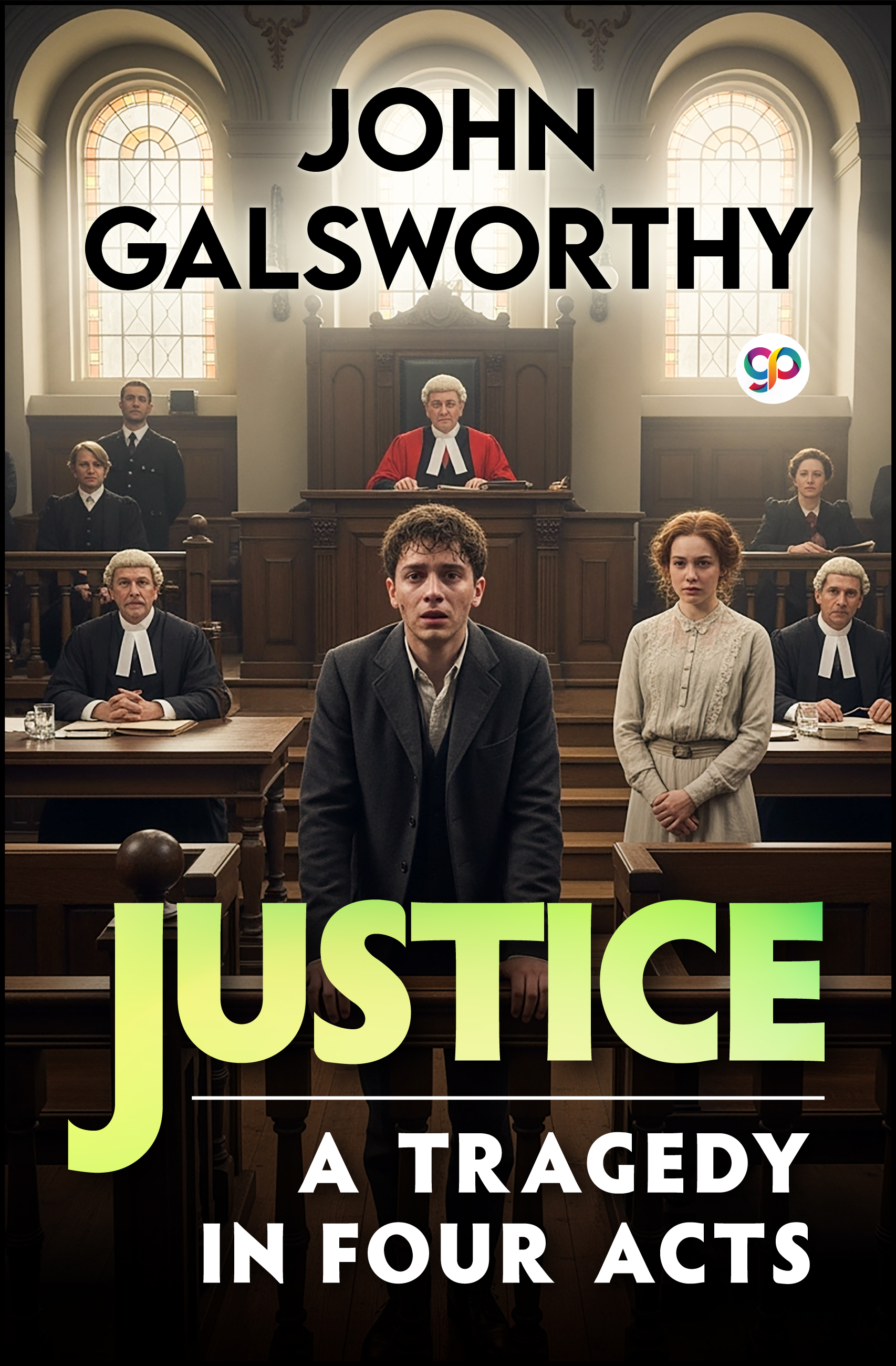
Justice (eBook)
Justice is a powerful play written by John Galsworthy and first performed and published in 1910. Galsworthy, an English novelist and playwright who later won the Nobel Prize in Literature in 1932, was known for his deep concern with social injustice and moral reform. Through his works, he exposed the flaws of British society, particularly the rigid class system and the cruelty of its legal and penal institutions.
In Justice, Galsworthy delivers a sharp critique of the British judicial and prison system, using drama to highlight the human cost of cold, bureaucratic laws. The play centers on William Falder, a young clerk who commits forgery in a desperate attempt to help the woman he loves escape an abusive marriage. Although his crime stems from compassion rather than greed, the legal system treats him with mechanical severity. Falder’s trial, conviction, and subsequent imprisonment reveal the harshness and moral blindness of a justice system more concerned with procedure than with mercy.
The play unfolds in four acts, moving from the office where the forgery occurs to the courtroom, the prison, and finally, the tragedy of Falder’s psychological collapse. Through realistic dialogue and emotional restraint, Galsworthy exposes how institutions designed to uphold justice often destroy individual lives. His portrayal of prison conditions, drawn from careful observation, shocked contemporary audiences and led to public debate about penal reform.
Justice is not merely a courtroom drama but a moral inquiry into the nature of right and wrong, punishment and compassion. It asks whether society’s laws truly serve humanity or merely preserve authority.
Profoundly humane and socially engaged, Justice remains one of Galsworthy’s most significant works — a timeless call for empathy and reform that helped awaken early 20th-century England to the need for a more compassionate system of justice.
BEST SELLERS



About the Author
John Galsworthy was an acclaimed English novelist and playwright, best known for his keen social observations and moral sensitivity. He was born on August 14, 1867, in Kingston Hill, Surrey, England, into a wealthy family. Educated at Harrow and New College, Oxford, Galsworthy initially studied law but soon turned to writing, driven by a desire to expose social injustices and explore human relationships with compassion and realism.
In his early literary career, Galsworthy published several novels and short stories, but his fame grew with his plays that tackled moral and social issues. One of his most significant works, “Justice” (1910), denounced the cruelty of the British prison system and contributed to reforms in penal policy. His other plays, such as Strife (1909) and The Silver Box (1906), similarly explored class conflict and inequality.
Galsworthy’s greatest achievement came with The Forsyte Saga (1906–1921), a sweeping series of novels chronicling the changing values of upper-middle-class England. For his literary contributions, he received the Nobel Prize in Literature in 1932.
Throughout his life, Galsworthy championed social reform and humane values through his writing. He died on January 31, 1933, in London, leaving a legacy of empathy, integrity, and enduring literary artistry.