
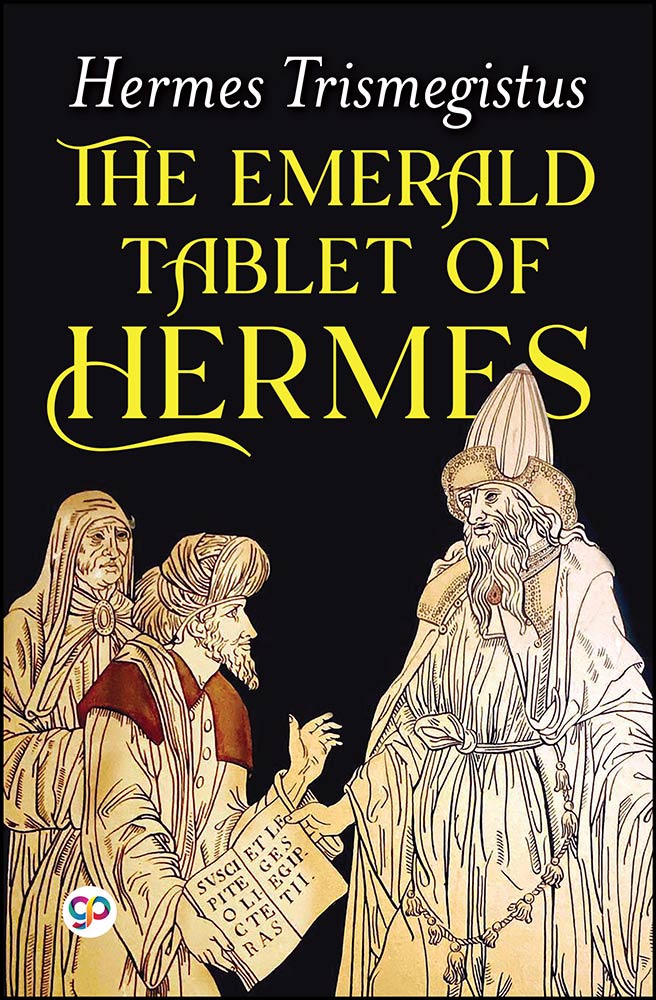
The Emerald Tablet of Hermes (eBook)
The Emerald Tablet was highly regarded in Europe as the founding document of alchemy. A foundation for the practice of magic, the power of the earth, fire, sun, and moon, can be found in interpretations of the words and their general meaning.
The Emerald Tablet of Hermes first appeared in alchemical libraries across Europe in the 12th century. Hermes Trismegistus-Thoth, who is said to have returned home with the Crusaders, is credited with creating this groundbreaking work. Modern magic has been influenced by the concepts still being discussed. The work had a significant impact on Western magic.
"The Emerald Tablet (Tabula smaragdina) by Hermes Trismegistus, which became the basic tenet of esoteric systems such as Tantra, Kabbalah, or the Hermetic tradition, confirms these observations with its message: “as above, so below” or “as without, so within.” Each of us is a microcosm containing, in some mysterious way, the entire universe."
—Stanislav Grof (The Way of the Psychonaut, Volume One: Encyclopedia for Inner Journeys)
BEST SELLERS




About the Author
Hermes Trismegistus is a legendary figure believed to be a fusion of the Egyptian god Thoth and the Greek god Hermes. Though not a historical person, he is credited with a vast body of mystical and philosophical writings known as the Hermetic Corpus, which profoundly influenced Western esoteric tradition, philosophy, and Renaissance thought. His name, meaning "Thrice-Great Hermes," reflects his supreme mastery in three fields: alchemy, astrology, and theurgy.
As a mythical sage rather than a real man, Hermes Trismegistus has no known early or middle life in a biographical sense. Instead, his supposed life story is symbolic, portraying him as a wise teacher who passed down divine knowledge to humanity. The Hermetic Corpus, including key texts like The Emerald Tablet and The Divine Pymander, teaches about the nature of the cosmos, the mind of God, and the path to spiritual enlightenment. His philosophy emphasizes the unity of all things and the famous maxim, “As above, so below.”
During the Middle Ages and Renaissance, Hermes was revered as a prophet and a source of ancient wisdom. Though not a historical author, his attributed works shaped alchemical thought, Neoplatonism, and early science. His symbolic “death” marks the decline of Hermeticism during the Enlightenment, yet his legacy endures in occult and philosophical circles.