
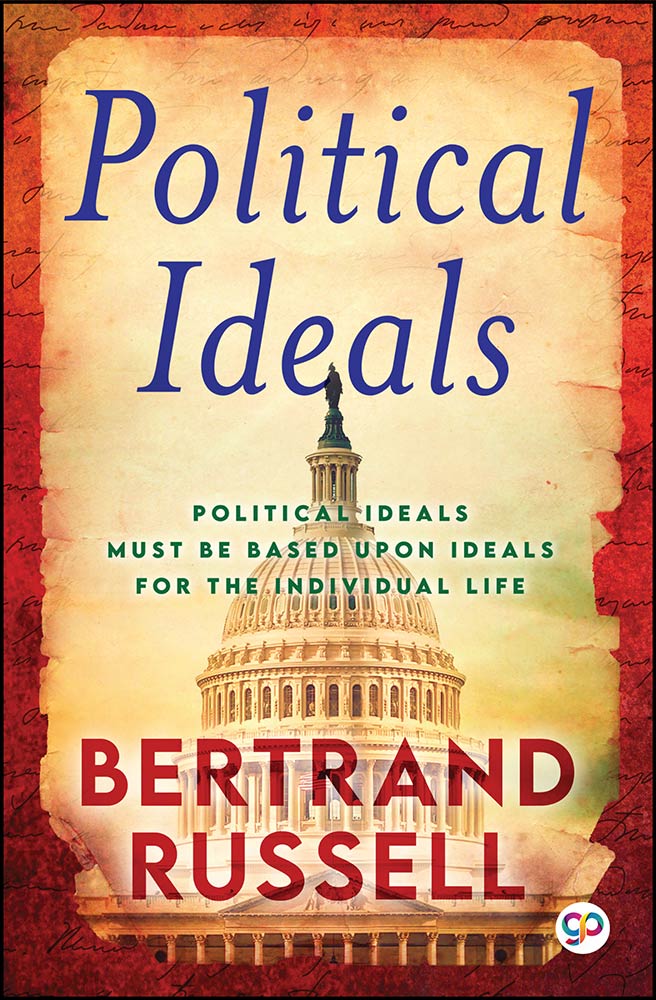
Political Ideals (eBook)
A thorough and significant examination of capitalism, socialism, and social structure can be found in Political Ideals. Political Ideals, which was written during the turmoil of World War One, is still important to anyone who is curious about the nature of a man's rights and obligations as a social being. In many ways, it is a declaration of Bertrand Russell's beliefs and the concepts that have shaped the way he views the most important historical moments of the 20th century.
For every student of this great philosopher, it is required reading in this regard. Because it encapsulates his core belief that politics should only be used to unleash the inherent creativity of people and to neutralize the forces of hegemony, convention, and acquiescence that threaten personal responsibility and freedom whenever they surface.
"The object of education ought not to be to make all men think alike, but to make each think in the way which is the fullest expression of his own."
—Bertrand Russell (Political Ideals)
BEST SELLERS


About the Author
Bertrand Russell (1872–1970) was a British philosopher, logician, mathematician, historian, and writer, widely regarded as one of the most influential thinkers of the 20th century. Born into an aristocratic family in Trellech, Wales, he was orphaned young and raised by his grandparents. Russell studied mathematics and philosophy at Trinity College, Cambridge, where he quickly distinguished himself as a brilliant intellect.
In his early career, Russell co-authored Principia Mathematica (1910–1913) with Alfred North Whitehead, a groundbreaking work in symbolic logic and the foundations of mathematics. He made significant contributions to analytic philosophy, especially in logic, epistemology, and the philosophy of language. His essay “On Denoting” (1905) became a cornerstone in the field.
During his middle life, Russell became a public intellectual and social critic. He was an outspoken pacifist during World War I, for which he was imprisoned, and later criticized totalitarianism and nuclear proliferation. His popular works like A History of Western Philosophy (1945) and Why I Am Not a Christian (1927) reached a broad audience.
Russell received the Nobel Prize in Literature in 1950 for his varied and significant writings. He remained active in political causes until his death in 1970 at age 97. His legacy spans both rigorous philosophy and humanist activism.