
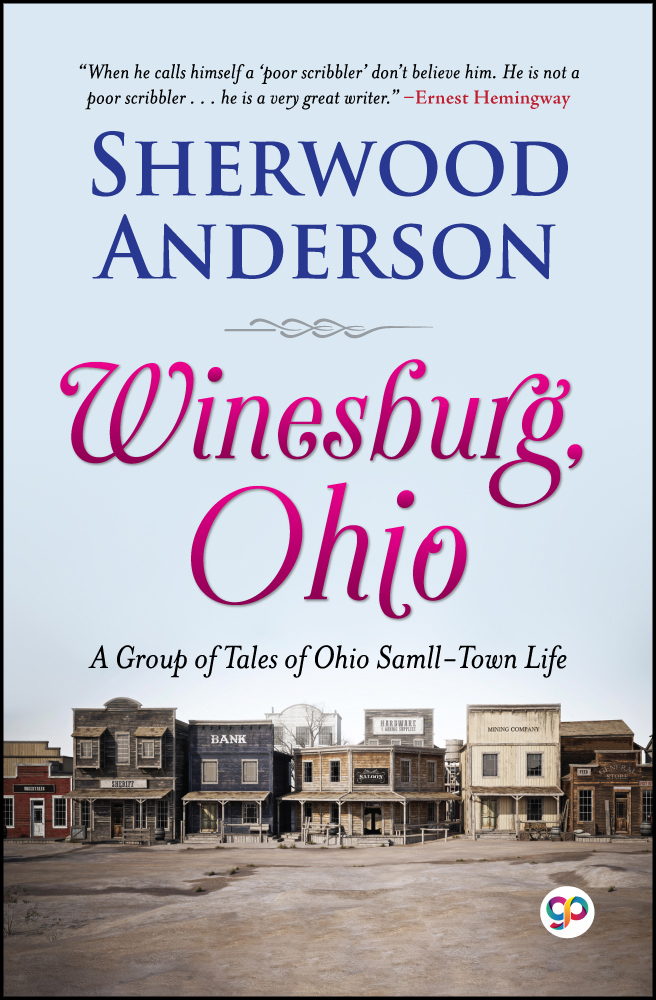
Winesburg, Ohio (Paperback)
"When he calls himself a 'poor scribbler' don't believe him. He is not a poor scribbler... he is a very great writer." —Ernest Hemingway
"Winesburg, Ohio is an extraordinarily good book. But it is not fiction. It is poetry." —Rebecca West
‘Winesburg, Ohio’ depicts the strange, secret lives of the inhabitants of a small town. In ‘Hands’, Wing Biddlebaum tries to hide the tale of his banishment from a Pennsylvania town, a tale represented by his hands. In ‘Adventure’, lonely Alice Hindman impulsively walks naked into the night rain. Threaded through the stories is the viewpoint of George Willard, the young newspaper reporter who, like his creator, stands witness to the dark and despairing dealings of a community of isolated people.
Sherwood Anderson was an American writer who was mainly known for his short stories, most notably the collection Winesburg, Ohio.
"I am a lover and have not found my thing to love. That is a big point if you know enough to realize what I mean. It makes my destruction inevitable, you see. There are few who understand that."
—Sherwood Anderson (Winesburg, Ohio)
BEST SELLERS


About the Author
Sherwood Anderson (September 13, 1876 - March 8, 1941) was an American novelist and short story writer, known for subjective and self-revealing works. Self-educated, he rose to become a successful copywriter and business owner in Cleveland and Elyria, Ohio. In 1912, Anderson had a nervous breakdown that led him to abandon his business and family to become a writer.
At the time, he moved to Chicago and was eventually married three more times. His most enduring work is the short-story sequence Winesburg, Ohio, which launched his career. Throughout the 1920s, Anderson published several short story collections, novels, memoirs, books of essays, and a book of poetry. Though his books sold reasonably well, Dark Laughter (1925), a novel inspired by Anderson's time in New Orleans during the 1920s, was the only bestseller of his career.
He may be most influential for his effect on the next generation of young writers, as he inspired William Faulkner, Ernest Hemingway, John Steinbeck, and Thomas Wolfe. He helped gain publication for Faulkner and Hemingway.