
A Journey to the Center of the Earth (GP Fine Illustrated Classics | 50+ Highly Detailed Illustrations (Paperback)
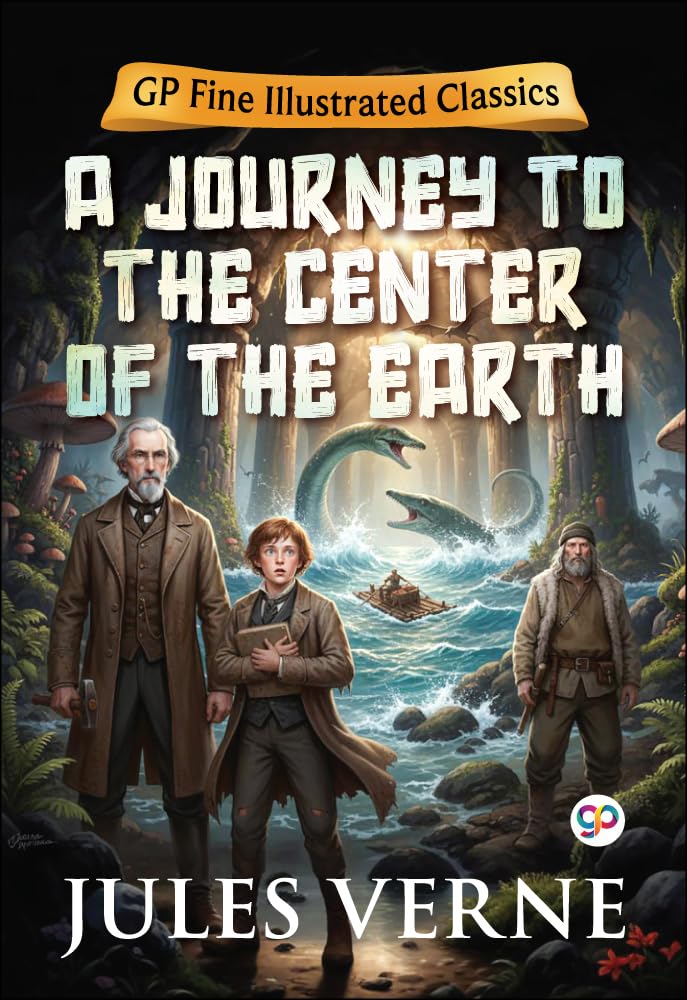
‘A Journey to the Center of the Earth’ by Jules Verne, is an exhilarating adventure that thrusts readers into a world of scientific discovery, geological wonders, and unimaginable peril. The novel, a cornerstone of speculative fiction, follows a determined German professor, his timid nephew, and a stoic Icelandic guide on an audacious expedition into the very core of our planet. It's a tale that masterfully blends meticulous scientific detail with high-stakes adventure, painting a vivid picture of a hidden world teeming with prehistoric life and breath-taking landscapes.
At the heart of the story is Professor Otto Lidenbrock, a man of profound knowledge and unwavering conviction. A brilliant and eccentric mineralogist from Hamburg, Lidenbrock is a force of nature—impatient, short-tempered, and utterly consumed by his scientific pursuits. His passion for geology is matched only by his single-minded determination. His nephew, Axel, is the narrator and our window into this extraordinary world. In stark contrast to his uncle, Axel is a cautious, nervous young man, more inclined to academic study than daring exploits. He is initially terrified by the prospect of the journey, but his loyalty to his uncle and his own burgeoning curiosity gradually draw him deeper into the adventure. The third member of the party is Hans Bjelke, an Icelandic eiderdown hunter who serves as their guide. Hans is the perfect foil to the two Germans—a man of few words, stoic and unflappable, with an almost supernatural ability to navigate treacherous terrain. His quiet competence and unwavering loyalty are instrumental to the trio's survival.
The adventure begins when Professor Lidenbrock discovers a cryptic cipher in a runic manuscript, written by the 16th-century Icelandic alchemist, Arne Saknussemm. The decoded message reveals a passage to the Earth's center through a dormant volcano, Snæfellsjökull, in Iceland. Despite Axel's vehement protests and his own scientific colleagues' skepticism, Lidenbrock is resolute. The two, accompanied by Hans, travel to Iceland and descend into the volcanic crater, beginning their perilous descent. The journey is a testament to both human endurance and the raw, untamed power of nature. The trio traverses a world of subterranean marvels, a world that exists only in Verne's imagination. They navigate a labyrinth of volcanic tunnels, their path illuminated by their own innovative lighting and the bioluminescent flora of the deep. They encounter a vast, underground ocean, a prehistoric sea teeming with giant marine reptiles like the Ichthyosaurus and Plesiosaurus, creatures thought to have been extinct for millions of years. This discovery is one of the novel's most iconic moments, a breath-taking fusion of paleontology and adventure. They build a raft and sail across this prehistoric sea, enduring a ferocious storm that hurls them to a hidden coastline. Here, they discover a primeval forest of gigantic mushrooms and a herd of mastodons, a living fossil record of an earlier epoch. The sheer scale and detail of these descriptions are a testament to Verne's imaginative genius, making the hidden world as much a character as the protagonists themselves.
The incidents are a mix of scientific discovery and life-or-death challenges. One of the most thrilling incidents is their desperate search for water. As they delve deeper, their supplies dwindle, and they face the terrifying prospect of dying of thirst. They find a subterranean river, the "Saknussemm Stream," a crucial lifeline that restores their hope. Another harrowing moment occurs when Axel gets separated from his uncle and Hans in a labyrinth of tunnels. His desperate cries echo in the dark, and his rescue by his uncle, guided by the sound of a distant waterfall, is a moment of profound relief and emotional connection. The climax of the journey is as dramatic as the descent itself. They are propelled upward by a volcanic eruption, not through the Icelandic volcano they entered, but through Stromboli, an active volcano on an island north of Sicily. The eruption, a terrifying display of nature's power, brings their incredible journey to a fiery, explosive end, returning them to the surface as heroes.
‘A Journey to the Center of the Earth’ is more than just an adventure story; it is a celebration of human curiosity and the unyielding spirit of exploration. It questions the limits of scientific knowledge and the very nature of our world. It's a timeless tale that continues to ignite the imagination of readers, inviting them to ponder the mysteries that lie beneath our feet.
BEST SELLERS











About the Author
Jules Verne, the ‘Father of Science Fiction’, stands as a colossal figure in the history of literature. His name is synonymous with adventure, technological marvels, and imaginative journeys that have captivated readers for over a century. From the depths of the ocean to the far reaches of space, Verne's mind was a crucible of scientific curiosity and boundless creativity. His works, collectively known as the Voyages Extraordinaires, are more than just thrilling tales; they are prophetic visions that foresaw the age of submarines, space travel, and aerial navigation. This deep dive into Verne's life and works will explore the formative years of his childhood, shed light on intriguing facts about the man behind the genius, and meticulously detail the literary masterpieces that have cemented his place as one of the most influential authors of all time.
Childhood: The Seeds of Adventure are Sown
Jules Gabriel Verne was born on February 8, 1828, in the port city of Nantes, France. His early life was steeped in an environment that would profoundly shape his future literary endeavors. Nantes, with its bustling harbor on the Loire River, was a gateway to the world. The constant arrival and departure of ships, laden with exotic goods and stories from distant lands, fueled the young Verne's imagination. He spent countless hours watching the vessels, dreaming of the adventures that lay beyond the horizon. This maritime atmosphere instilled in him a lifelong fascination with travel, geography, and the vast, unexplored wonders of the world's oceans.
His father, Pierre Verne, was a respected lawyer, and his mother, Sophie Allotte de la Fuÿe, came from a family of shipowners and navigators. This blend of legal precision and seafaring heritage proved to be a powerful influence. While his father hoped he would follow in his footsteps and pursue a career in law, Jules's heart was already set on a different course. He was a voracious reader, devouring adventure novels and scientific journals alike. His early education at a seminary school was traditional, but his mind was anything but. He was drawn to the nascent fields of science and technology, a passion that was not common among his peers.
A legendary, though possibly apocryphal, story from his childhood perfectly encapsulates his adventurous spirit. At the age of eleven, he supposedly stowed away on a ship bound for the West Indies, hoping to bring back a coral necklace for his cousin and crush, Caroline Tronson. He was quickly caught by his father, who brought him back home. The story, whether true or not, is a powerful metaphor for his later life. It demonstrates his innate desire to escape the mundane and embark on daring voyages, a theme that would become the cornerstone of his literary career.
Interesting Facts: Beyond the Books
Jules Verne's life was as fascinating as his fiction. Here are some interesting facts that provide a deeper understanding of the man behind the stories:
A Reluctant Lawyer: Despite his father's wishes, Verne found law to be an uninspiring profession. He moved to Paris to study law in 1847 but spent more time in the city's literary and theatrical circles. He wrote plays, librettos, and poetry, finding his true calling in the creative arts. His legal studies were a mere formality, a means to an end before he could fully commit to his passion.
Collaboration with the "Magus": Verne's literary career truly took off after he met publisher Pierre-Jules Hetzel. Hetzel, a visionary and shrewd businessman, recognized the unique blend of adventure and science in Verne's writing. He encouraged Verne to focus on this niche, leading to the creation of the Voyages Extraordinaires series. Hetzel was more than just a publisher; he was a mentor and a collaborator, often pushing Verne to refine his ideas and ensure scientific accuracy. He even gave Verne the idea for Around the World in Eighty Days after seeing a newspaper article about a new train line.
Scientific Accuracy and Prophetic Visions: Verne was not a scientist himself, but he was a meticulous researcher. He maintained a vast personal library and a massive collection of newspaper clippings and scientific articles. He was an honorary member of the French Geographical Society and was often consulted by scientists of his time. This dedication to research allowed him to weave authentic scientific principles into his fictional narratives. He was a true prophet of technology, accurately predicting the existence of helicopters (in Robur the Conqueror), electric submarines (in Twenty Thousand Leagues Under the Sea), and even fax machines.
A Near-Fatal Shooting: In 1886, Verne was shot in the leg by his nephew, Gaston, who was reportedly mentally unstable. The wound left him with a permanent limp and profoundly affected his life and work. The incident led to a darker, more somber tone in his later novels, which often explored themes of madness, isolation, and technological hubris.
The Voyages Extraordinaires and its Scope: The Voyages Extraordinaires (or "Extraordinary Journeys") is a collection of 54 novels, 14 novellas, and various short stories. The stated purpose of the series, as outlined by Hetzel, was to "summarize all the geographical, geological, physical, astronomical knowledge amassed by modern science." It was an ambitious project, a literary encyclopedia that sought to educate and entertain.
The Works: A Legacy of Imagination and Innovation
Jules Verne's literary output is a testament to his prolific talent and unflagging imagination. His works can be broadly categorized into several thematic groups, but they are all united by a sense of wonder and a deep respect for the power of human ingenuity.
The Early Masterpieces: The Genesis of the Voyages
Five Weeks in a Balloon (1863): This was Verne's first major success and the book that launched the Voyages Extraordinaires series. It follows the adventures of a group of British explorers as they traverse the African continent in a hot air balloon. The novel was a sensation, captivating the public with its detailed descriptions of geography and its thrilling plot. It established the formula that would define Verne's career: a journey through a foreign land, a group of intrepid adventurers, and a rich tapestry of scientific and geographical facts.
Journey to the Center of the Earth (1864): This classic novel takes readers on a descent into the planet's core. A German professor, Otto Lidenbrock, and his nephew, Axel, follow a cryptic message left by an Icelandic alchemist, discovering a subterranean world filled with prehistoric creatures and strange landscapes. The novel is a brilliant blend of adventure and speculative science, exploring concepts of geology and paleontology in a way that was both accessible and exciting.
From the Earth to the Moon (1865) and Around the Moon (1870): These two novels are Verne's most audacious visions. They tell the story of the Baltimore Gun Club, a group of American engineers who build a giant cannon to launch a manned projectile to the moon. The books, written a century before the Apollo missions, are astonishingly accurate in their predictions. Verne correctly foresaw the use of a space capsule, the concept of a multi-stage rocket (though his cannon was a singular, massive device), and even the weightlessness experienced in space. He also located the launch site in Florida, a remarkable coincidence given the later choice of Cape Canaveral.
The Iconic Adventures: Characters and Technology
Twenty Thousand Leagues Under the Sea (1870): This is arguably Verne's most famous and enduring work. It introduces the enigmatic and complex Captain Nemo and his technological marvel, the submarine Nautilus. The novel is a masterpiece of adventure, mystery, and scientific speculation. The descriptions of the undersea world are breathtaking, and the Nautilus, with its electric propulsion and advanced features, was a truly visionary creation. The character of Captain Nemo, a tormented genius who has renounced humanity, adds a layer of psychological depth that elevates the book beyond a simple adventure story.
Around the World in Eighty Days (1873): This novel, a race against time, is a departure from Verne's more science-heavy works. It focuses on the sheer excitement of travel and the eccentricities of its protagonist, Phileas Fogg. Fogg, a meticulous and unflappable English gentleman, bets his friends that he can circumnavigate the globe in eighty days. The journey, filled with unexpected delays and cultural encounters, is a celebration of Victorian ingenuity and the spirit of global exploration. The book's breakneck pace and witty dialogue have made it a timeless classic.
Later Works and Enduring Themes
The Mysterious Island (1875): Often considered the spiritual successor to Robinson Crusoe, this novel follows a group of American Civil War prisoners who escape in a hot air balloon and land on an uncharted island. They use their scientific knowledge and resourcefulness to build a new civilization from scratch. The novel is a paean to the power of science and human collaboration, as the characters transform the island into a thriving paradise. The book also features a surprise cameo from Captain Nemo, linking it to the wider Voyages Extraordinaires universe.
Robur the Conqueror (1886) and Master of the World (1904): These novels introduce another technological genius, Robur, a foil to Captain Nemo. Robur, who commands a series of flying machines, believes that humanity should be ruled by the elite few who possess superior technology. The books explore the darker side of technological progress and the potential for its misuse. They are a reflection of Verne's later, more pessimistic outlook on the world.
Jules Verne's legacy is immense. His books have been translated into countless languages, adapted into numerous films and television shows, and have inspired generations of scientists, engineers, and adventurers. He was not just a storyteller; he was a futurist who saw the potential for humanity to conquer the elements and explore the unknown. He passed away on March 24, 1905, but his "extraordinary voyages" continue to sail, fly, and dive, carrying readers to the farthest reaches of imagination and beyond. His work remains a powerful reminder that the greatest adventures are often found not on a map, but within the pages of a book.