
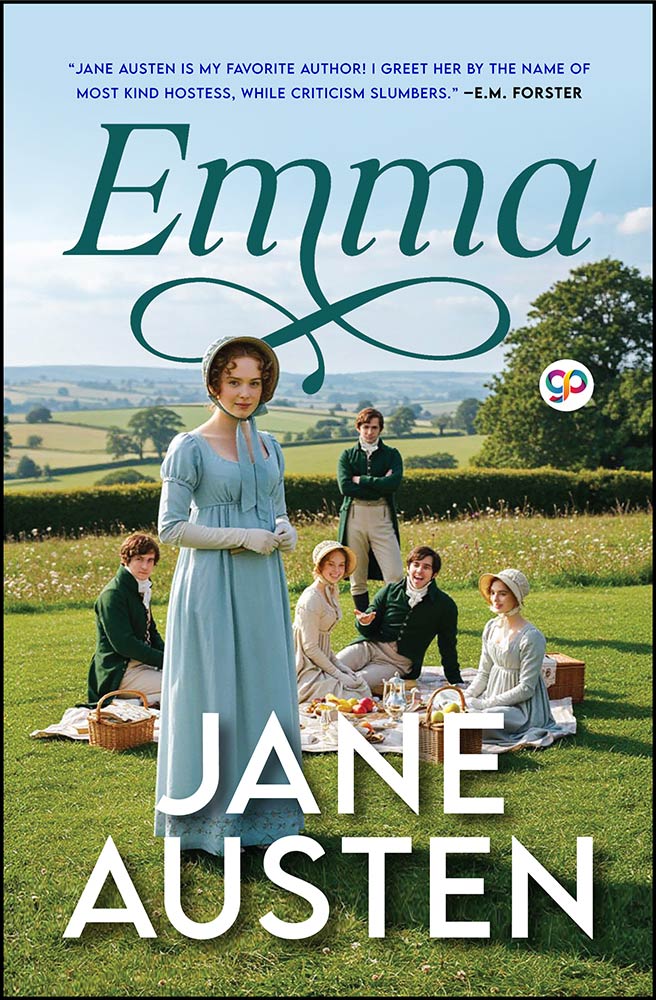
Emma (eBook)
"Jane Austen is my favorite author! ... Shut up in measureless content, I greet her by the name of most kind hostess, while criticism slumbers." —E.M. Forster
First published in 1815, ‘Emma’ is a timeless novel by celebrated English author Jane Austen, known for her sharp wit, keen social commentary, and mastery of character-driven storytelling. Austen’s novels have long been admired for their elegant prose and insightful exploration of relationships, class, and the roles of women in early 19th-century society.
Emma follows the charming, wealthy, and self-assured Emma Woodhouse, a young woman who fancies herself a skilled matchmaker. Confident in her judgment, Emma meddles in the romantic affairs of those around her, believing she knows what is best for everyone—except herself. As her matchmaking efforts unravel and lead to unexpected consequences, Emma begins to recognize her own flaws and misunderstandings about love, friendship, and self-awareness.
Set in the idyllic English countryside, the novel offers a brilliant portrait of social manners and the complexities of human behavior. With its rich characters, sparkling dialogue, and gentle irony, ‘Emma’ is both a romantic comedy and a journey of personal growth. It remains one of Austen’s most beloved works, continuing to enchant readers with its wit, charm, and timeless insight into the human heart.
BEST SELLERS








About the Author
Jane Austen (1775–1817) was an English novelist whose insightful, often humorous, and subtly biting social commentary and masterful use of free indirect speech established her as one of the most widely read writers in English literature. Her novels typically explore the lives of the gentry, focusing on the reliance of respectable women on marriage for social standing and economic security.
Born on December 16, 1775, in the village of Steventon, Hampshire, Jane was the seventh of eight children and the second daughter of the Reverend George Austen, a well-educated clergyman, and his wife, Cassandra Leigh. She lived her entire life within a close-knit family environment. Her education was informal but superior to that of most young women of her time, consisting of reading from her father's extensive library, brief periods at boarding school, and continuous instruction at home. Her relationship with her only sister, also named Cassandra, was profoundly intimate and lifelong.
Austen began writing seriously in her teenage years, composing lively parodies of existing literary conventions. These early works, collected posthumously as Juvenilia, display her characteristic wit and satirical edge. Her family served as her first, supportive audience, often reading her manuscripts aloud. In 1801, her father retired, and the family moved to Bath, a fashionable resort city that would later feature prominently in her novels. Following her father's death in 1805, Austen, her mother, and Cassandra faced financial hardship and relied on the support of her brothers. They eventually settled in Chawton Cottage in Hampshire in 1809, a period that proved to be her most productive in terms of writing and publishing.
Austen published her major novels anonymously, with the title page simply reading "By a Lady." This was typical for female authors of her era, as writing for profit was considered less than respectable for a woman of her social class. Her first published novel was ‘Sense and Sensibility’ (1811), which achieved modest success. This was quickly followed by her most beloved work, ‘Pride and Prejudice’ (1813), originally titled First Impressions. The novel's spirited heroine, Elizabeth Bennet, and the proud, complex Mr. Darcy became instant literary icons.
Over the next five years, she published ‘Mansfield Park’ (1814) and ‘Emma’ (1815). Emma, which Austen herself described as a character "whom no one but myself will much like," is often considered her most structurally perfect novel, known for its focus on a flawed but well-meaning heroine. Her novels are distinguished by their focus on the intricacies of manners, social class, and gender roles in early 19th-century English society. While her scope is often limited to the country estates and drawing-rooms of the gentry, her psychological insights into human vanity, self-deception, and moral judgment are universal and enduring. Austen’s health began to decline around 1816, likely due to Addison's disease. Despite her illness, she continued to work, and two more novels, ‘Persuasion’ and ‘Northanger Abbey’, were completed but published posthumously in 1818.
Jane Austen died in Winchester on July 18, 1817, at the age of 41. Although her novels were popular during her lifetime, her genius was fully recognized only after her death. Today, her works remain foundational texts of English literature, continually adapted for film and television, and cherished for their timeless wit and romantic sensibility.