
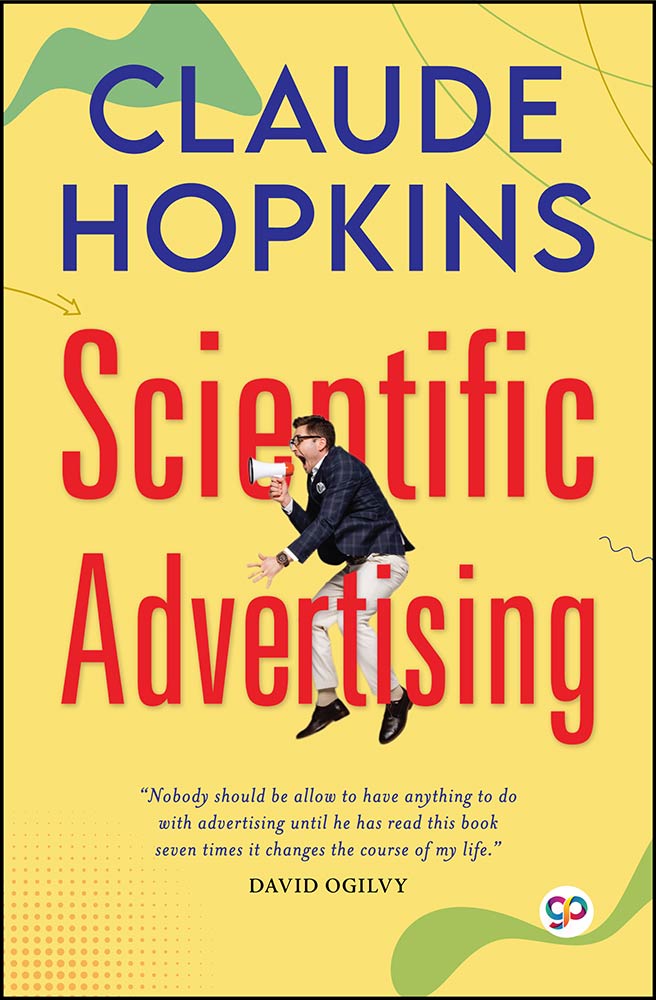
Scientific Advertising (eBook)
It has now reached a point where, in some hands, marketing is considered to be a science. It is based on fixed principles and is reasonably exact. The causes and effects have undergone extensive analysis in order to fully comprehend them. There is evidence supporting and establishing the correct procedure. We follow fundamental law because we know it to be the most effective. Thus, under capable management, one of the safest business ventures has evolved from advertising, once a gamble. There is undoubtedly no other business with comparable potential that needs to carry such little risk. Because of this, this book deals with established principles and facts rather than theories and opinions. It is designed to serve as both a safe reference for advertisers and a textbook for students. Each statement has been considered carefully. The book's focus is strictly on laying the groundwork.
"Remember the people you address are selfish, as we all are. They care nothing about your interests or profit. They seek service for themselves. Ignoring this fact is a common mistake and a costly mistake in advertising."
—Claude C. Hopkins (Scientific Advertising)
BEST SELLERS



About the Author
Claude C. Hopkins (1866-1932) was one of the great advertising pioneers, he believed advertising existed only to sell something and should be measurable and justify the results that it produced. He worked for various advertisers, including Bissell Carpet Sweeper Company, Swift & Company and Dr. Shoop's patent medicine company. At the age of 41, he was hired by Albert Lasker owner of Lord & Thomas advertising in 1907 at a salary of $185,000 a year, Hopkins insisted copywriters researched their client products and produce reason-why copy. He believed that a good product was often its own best salesperson and as such he was a great believer in sampling. To track the results of his advertising he used key coded coupons and then tested headlines, offers and propositions against one another. He used the analysis of these measurements to continually improve his ad results, driving responses and the cost effectiveness of his clients advertising spend. His classic book, "Scientific Advertising," was published in 1923, following his retirement from Lord & Thomas, where he finished his career as president and chairman. He died in 1932.