
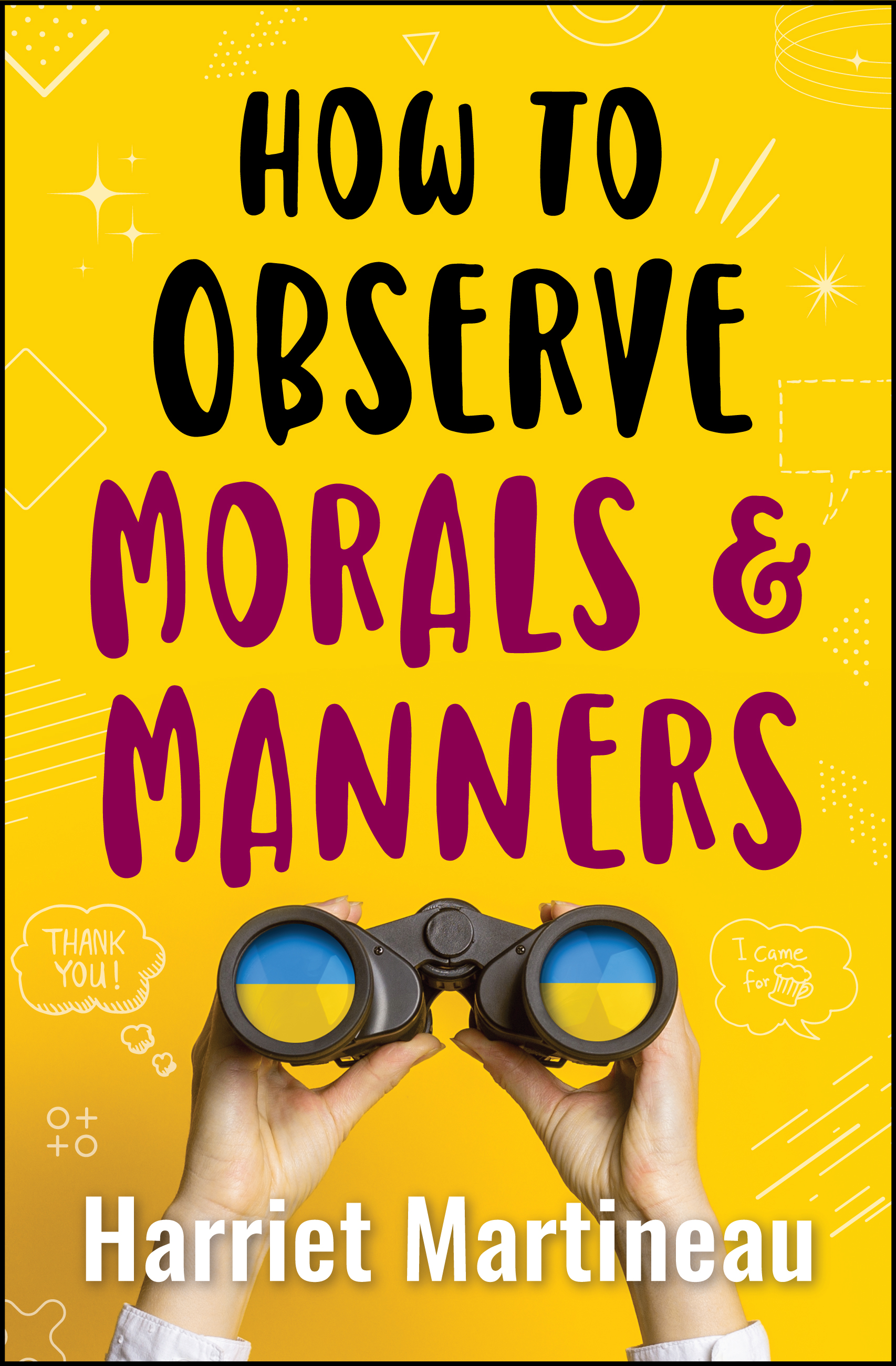
How to Observe: Morals and Manners (eBook)
How to Observe: Morals and Manners is a pioneering work by Harriet Martineau, first published in 1838. Martineau was an English writer, sociologist, and social reformer, often regarded as one of the founders of modern sociology. Known for her intellectual independence and advocacy for women’s rights, education, and social justice, she sought to make complex ideas about society accessible to a general audience.
This book is one of the earliest systematic guides to sociological observation, offering practical advice on how to study and understand human behavior, customs, and moral values within a society. Martineau wrote it after her travels in America, where she studied the culture, politics, and daily life of its people. Through this work, she aimed to provide a scientific framework for travelers, reformers, and social scientists to observe societies objectively, without bias or moral superiority.
Martineau distinguishes between “morals” — the underlying principles and values that shape a society’s behavior — and “manners”, the outward expressions of those morals through everyday customs and practices. She emphasizes that to truly understand a people, one must look beyond surface appearances to grasp the deeper moral foundations that guide their actions. Her approach advocates empathy, impartiality, and respect for cultural differences, principles that remain central to modern social research.
How to Observe: Morals and Manners is significant not only as an early methodological text but also as a reflection of Martineau’s commitment to equality and rational inquiry. It challenged the ethnocentric attitudes of her time and laid the groundwork for future studies in anthropology and sociology.
Today, the book stands as a landmark in social science literature, notable for its clarity, foresight, and moral depth — a remarkable contribution from one of the 19th century’s most insightful and courageous thinkers.
BEST SELLERS


About the Author
Harriet Martineau was a pioneering English writer, sociologist, and social theorist, born on June 12, 1802, in Norwich, England. Often regarded as the first female sociologist, she used her writing to explore politics, economics, and society from a moral and humanistic perspective.
Born into a large Unitarian family, Martineau was largely self-educated and began writing to support herself after her family’s financial decline. Her early essays appeared in The Monthly Repository, leading to her breakthrough work, Illustrations of Political Economy (1832–1834), a series of stories that explained economic principles in plain language. These writings made her one of the most influential public intellectuals of her time.
In her middle years, Martineau traveled widely, including a notable visit to the United States, which inspired Society in America (1837), a critical examination of slavery, gender inequality, and democratic ideals. Her other major works include How to Observe: Morals and Manners (1838), one of the earliest methodological guides in sociology, and Deerbrook (1839), a novel exploring middle-class life.
Despite chronic illness and partial deafness, Martineau continued writing prolifically, producing over 50 books and countless essays. She died on June 27, 1876, in Ambleside, England, leaving behind a legacy as a trailblazer in sociology, feminism, and social reform.