
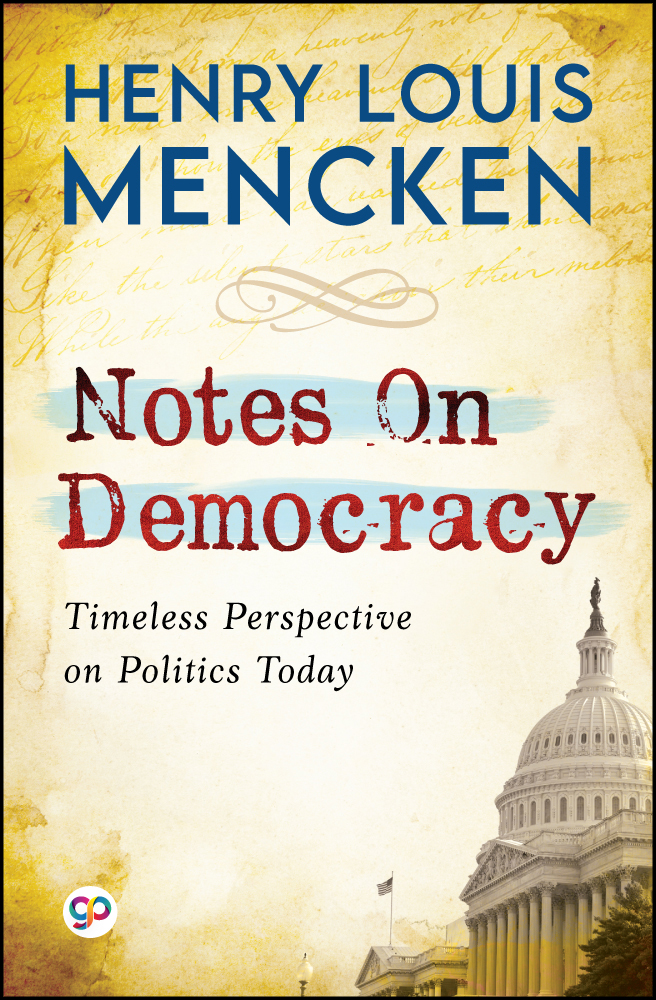
Notes on Democracy (Hardcover)
Democracy came into the Western World to the tune of sweet, soft music. There was, at the start, no harsh bawling from below there was only a dulcet twittering from above. Democratic man thus began as an ideal being, full of ineffable virtues and romantic wrongs in brief, as Rousseau’s noble savage in smock and jerkin, brought out of the tropical wilds to shame the lords and masters of the civilized lands.
The fact continues to have important consequences to this day. It remains impossible, as it was in the eighteenth century, to separate the democratic idea from the theory that there is a mystical merit, an esoteric and ineradicable rectitude, in the man at the bottom of the scale—that inferiority, by some strange magic, becomes a sort of superiority—nay, the superiority of superiorities.
BEST SELLERS
About the Author
Henry Louis "H.L." Mencken became one of the most influential and prolific journalists in America in the 1920s and '30s, writing about all the shams and con artists in the world. He attacked chiropractors and the Ku Klux Klan, politicians and other journalists. Most of all, he attacked Puritan morality. He called Puritanism, "the haunting fear that someone, somewhere, may be happy."
At the height of his career, he edited and wrote for The American Mercury magazine and the Baltimore Sun newspaper, wrote a nationally syndicated newspaper column for the Chicago Tribune, and published two or three books every year. His masterpiece was one of the few books he wrote about something he loved, a book called The American Language (1919), a history and collection of American vernacular speech. It included a translation of the Declaration of Independence into American English that began, "When things get so balled up that the people of a country got to cut loose from some other country, and go it on their own hook, without asking no permission from nobody, excepting maybe God Almighty, then they ought to let everybody know why they done it, so that everybody can see they are not trying to put nothing over on nobody."
When asked what he would like for an epitaph, Mencken wrote, "If, after I depart this vale, you ever remember me and have thought to please my ghost, forgive some sinner and wink your eye at some homely girl."